- Emergency lighting
- Emergency escape lighting
- Escape-route lighting
- Safety signs
- Dynamic safety signs
- Open-area (anti-panic) lighting
- High-risk task-area lighting
- Escape-route lighting
- Standby lighting
- Emergency escape lighting
Knowledge Centre
Emergency lighting handbook: an accessible guide to standards, design, installation, battery systems and maintenance.
- 01Laws, standards and regulationsAn overview of the Croatian and European technical framework for the design, installation and assessment of emergency lighting. It identifies the relevant standards and their areas of application.
- 02Emergency lighting luminairesPlacement of emergency luminaires, illumination of escape routes, open-area lighting, high-risk task areas, safety signs and visibility of exit pictograms. The chapter brings together the corresponding diagrams and explanations from the handbook.
- 03Systems and cablingA comparison of self-contained luminaires, self-contained systems with central monitoring, low-power supply (LPS) systems and central power supply (CPS) systems, including installation and cabling considerations. It also explains how system selection affects monitoring, equipment rooms and cable routing.
- 04Autonomy and batteriesOperating duration, maintained and non-maintained modes, battery technologies, design considerations and ventilation for emergency lighting power supplies. The autonomy tables and descriptions can be read directly as HTML, with the original source available for checking.
- 05Inspection and maintenanceResponsibilities, testing, record-keeping and the long-term reliability of emergency lighting systems, based on the handbook and its technical references. The chapter distinguishes routine checks, documentation and responsibilities described in the handbook.
- 06Frequently asked questionsAnswers to selected technical questions on central battery systems, cable integrity, maintenance, battery selection and switching behaviour, following the questions in the source handbook. Answers are provided in readable text alongside the original handbook references.
About the handbook
Prepared by Sibeling, the second edition of the Emergency Lighting Handbook was published in May 2026. The original Croatian publication brings together lighting standards, design principles, technical illustrations and frequently asked questions.
The English edition provides the full text for every source page, with the original high-resolution technical illustrations available for reference.
Introduction to emergency lighting
Emergency lighting becomes relevant when the supply to normal lighting fails. Its purpose is to support safe evacuation, make emergency equipment identifiable and allow hazardous activities to be stopped safely.
Emergency lighting includes escape route lighting, open-area (anti-panic) lighting and lighting of high-risk task areas. The original handbook illustrates these categories through a detailed schematic based on HRN EN 1838:2025.
How the handbook was created
HOW THE HANDBOOK CAME ABOUT
Every high-quality product begins with a vision and passion arising from market needs and anticipating how the market will develop in the future. That is how this Handbook came into being. We looked beyond our country's borders, studied regulations in Western countries and translated them ourselves so that we could learn more and put that knowledge to use in our projects. Month after month, our information grew as standards changed, technology developed and our understanding of safety systems improved. We wanted to pass this acquired knowledge on to the market, so we began running training courses on standards and emergency lighting design at the training centre established at our company's headquarters.
The next logical step was to bring together all the information we had collected and translated in one place — the Emergency Lighting Handbook. Our intention was to make it entirely transparent, free of commercial bias and based on the latest applicable standards and regulations in Croatia, Austria and Germany (German-speaking countries that have developed the most detailed rules in the field of emergency lighting). Every piece of information in this Handbook has a clearly stated, verifiable source. We also wanted to provide the market with clear, comprehensible information in Croatian about current regulations and standards and, through the Handbook, establish a common basis for discussing this topic.
We believe we achieved this in this edition and that subsequent editions will be even better.
Respectfully, Zoran Čovran
“Tradition is not the worship of ashes, but the passing on of fire.”
About Sibeling
WHO WE ARE
sibeling d.o.o. was founded in 2022 with the aim of offering the market high-quality solutions supported by expertise in a very important but often neglected area — emergency lighting. We built our experience over many years of market activity, from design and sales to support during installation. We are part of a positive change and focus on solving problems. We believe that our knowledge, investments in professional development and in the company itself can help raise standards and awareness of this aspect of every project. We want to be a centre of knowledge, professionalism and expertise in emergency lighting. Emergency lighting is what we do.
To remain relevant in the markets where we operate, we continue to develop our expertise, participate in projects from the design stage, are present on site during implementation and return for maintenance and servicing. We love what we do.
What is emergency lighting?
EMERGENCY LIGHTING
EMERGENCY LIGHTING
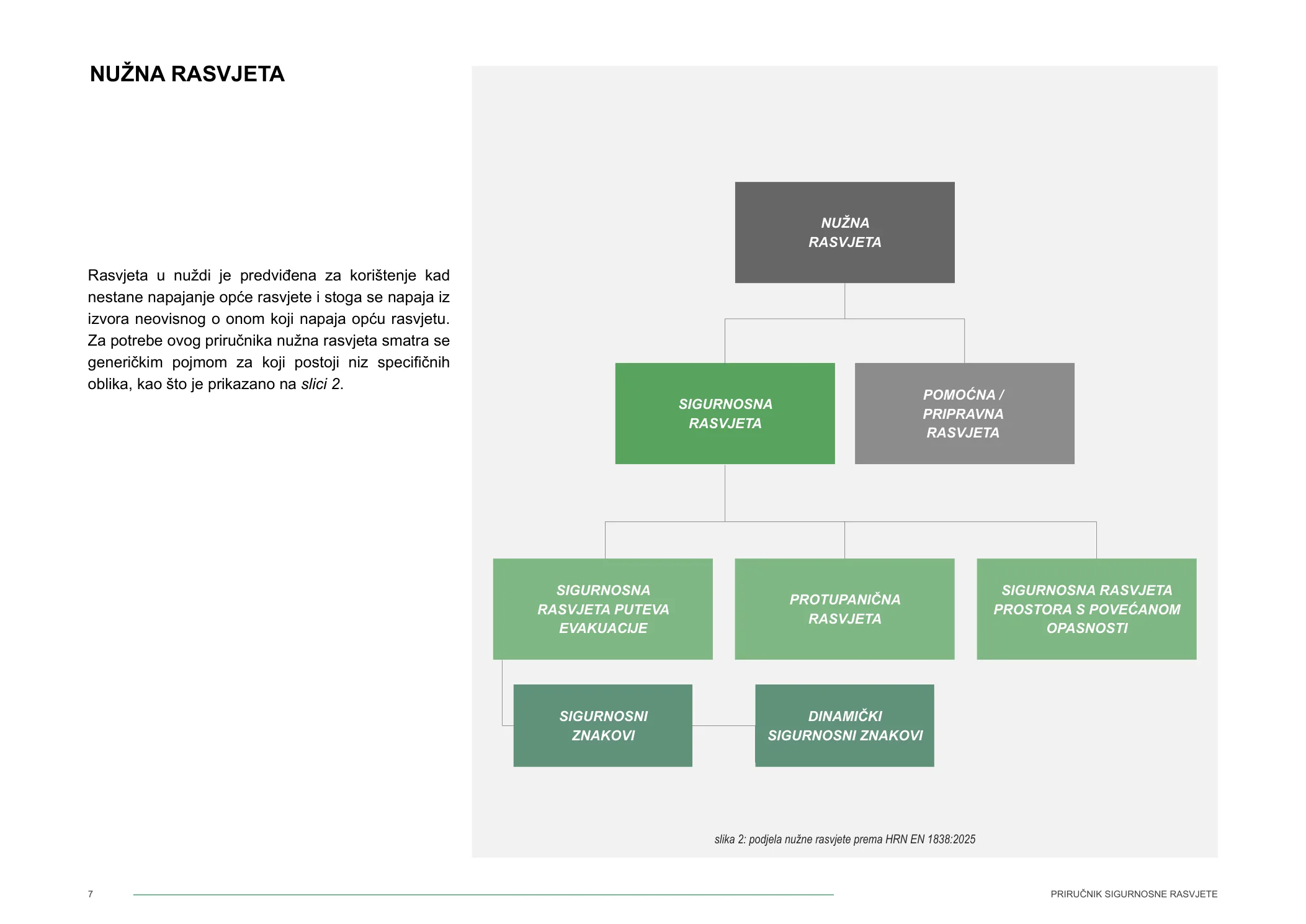
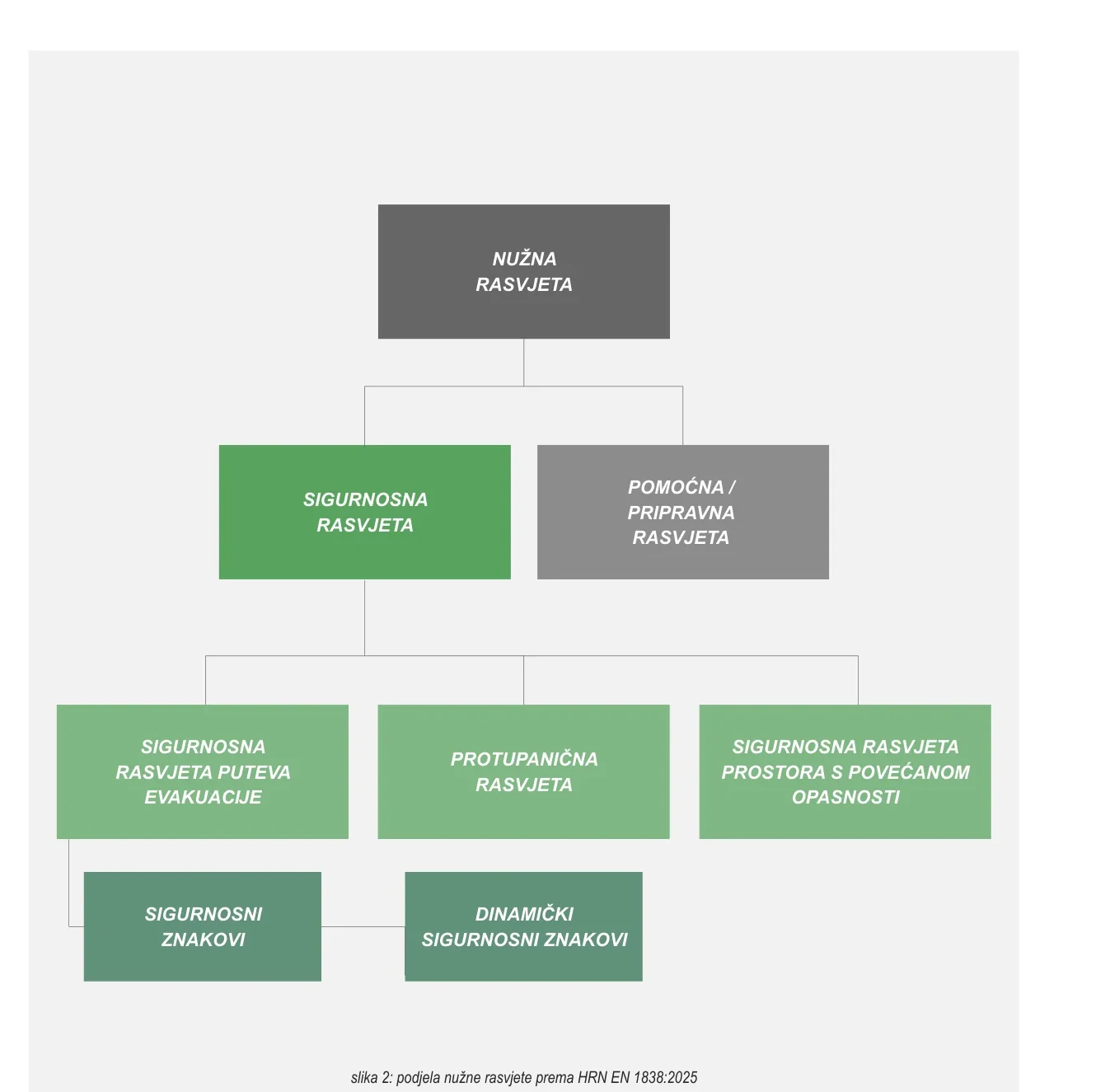
Emergency lighting is intended for use when the normal lighting power supply fails and is therefore supplied from a source independent of the one powering normal lighting. For the purposes of this Handbook, emergency lighting is a generic term encompassing several specific forms, as shown in Figure 2.
STANDBY LIGHTING
EMERGENCY ESCAPE LIGHTING
ESCAPE ROUTE LIGHTING
OPEN AREA (ANTI-PANIC) LIGHTING
HIGH-RISK TASK AREA LIGHTING
SAFETY SIGNS
DYNAMIC SAFETY SIGNS
Figure 2: Classification of emergency lighting according to HRN EN 1838:2025.
Classification of emergency lighting
Types of emergency lighting
EMERGENCY LIGHTING
EMERGENCY ESCAPE LIGHTING
STANDBY LIGHTING
(emergency lighting)
(emergency escape lighting)
(standby lighting)
Lighting that permits the safe evacuation of people from a building in the event of a failure of mains power to the normal lighting system and also allows high-risk activities in hazardous areas to be terminated safely. It is divided into standby lighting and emergency escape lighting.
The part of emergency lighting whose function is to provide direction and sufficient illumination so that people can evacuate safely from the building or reach a safe place within it. It also enables high-risk activities to be stopped safely so as to prevent additional accidents.
The part of emergency lighting that allows activities to continue without interruption when mains power fails (for example, a basketball game or a performance) by switching to backup power sources (generators, UPS, etc.). Under HRN EN 1838, standby lighting is classed as emergency lighting, but it does not perform a safety function and is not mandatory by law.
ESCAPE ROUTE LIGHTING
HIGH-RISK TASK AREA LIGHTING
ADAPTIVE (DYNAMIC) EMERGENCY ESCAPE LIGHTING
OPEN AREA (ANTI-PANIC) LIGHTING
(escape route lighting)
(open area lighting)
(high-risk task area lighting)
The part of emergency escape lighting that indicates the correct direction of travel towards the building exit using safety signs (pictograms), provides the necessary illuminance of escape routes and allows fire-fighting and safety equipment to be found and used easily. It includes escape route lighting, illuminated safety signs and low-mounted directional markers.
Emergency lighting for large open areas is intended to reduce the likelihood of panic by providing adequate illumination and guiding people towards an escape route.
Adaptive lighting can supplement conventional emergency escape lighting and increase its effectiveness in emergencies. Such a system includes internally illuminated safety signs (pictograms) that can dynamically change the displayed information to indicate alternative escape routes or warn that a particular route is closed or temporarily unavailable.
The part of emergency lighting that enables the safe evacuation of people engaged in potentially hazardous processes and the termination of high-risk activities in hazardous areas, to prevent further accidents.
The handbook text may be quoted with attribution and a link to sibeling.com. Photographs, drawings and diagrams require separate rights clearance.
This translation requires final technical review before production approval.