Required autonomy
The necessary operating duration depends on the building use, evacuation strategy and relevant legal and technical requirements. The source handbook contains a comparison table for buildings of different purposes. Its entries must be interpreted in their regulatory context and verified for the actual project.
Maintained and non-maintained operation
In maintained mode, the luminaire or safety sign is lit during normal operation and continues to operate from the emergency supply following a power failure. In non-maintained mode, the emergency luminaire normally activates when the normal supply fails. A combination of operating modes may be used where the selected system supports it.
Battery technologies
The handbook compares VRLA lead-acid batteries, lithium iron phosphate (LiFePO4/LFP), nickel-cadmium (NiCd), nickel-metal hydride (NiMH) and supercapacitors. Criteria include design life, energy density, cycling, temperature behaviour, maintenance, environmental impact and compatibility with the charge-management system.
Ventilation and safety
Stationary battery systems may release gases during charging, depending on chemistry and operating conditions. Ventilation requirements and room design must be evaluated using the relevant battery safety standard, battery manufacturer data, charging current and intended battery arrangement. In the source document, the ventilation calculation is accompanied by explanatory diagrams.
Inspection and replacement
The available battery capacity changes with age, temperature and operating history. Periodic functional checks, documented autonomy tests and replacement in accordance with approved maintenance procedures help maintain the required emergency operating duration.
Required autonomy by building use — part one
| Building type / use | Building size | Autonomy (h) | Other building size | Autonomy (h) |
|---|---|---|---|---|
| Theatres, cinemas and exhibition halls | ≤ 240 people | 1 (a) | > 240 people | 3 |
| Temporary buildings used as meeting halls | N/A | 1 | — | — |
| Retail premises and exhibition halls | ≤ 3000 m² | 1 | > 3200 m² | 3 |
| Restaurants and hospitality establishments | N/A | 2 (1)(2) | — | — |
| Hospitals | N/A | 3 (b) | — | — |
| Care homes for elderly and dependent people | ≤ 16 beds | 1 | > 16 beds | 3 |
| Accommodation, student residences and similar buildings | ≤ 100 people | 1 | > 100 people | 3 |
| Hotels | N/A | 3 (2) | — | — |
| Spa, care and therapeutic treatment centres | N/A | 3 | — | — |
| Schools, kindergartens and similar buildings | ≤ 3200 m² | 1 (a) | > 3200 m² | 3 |
| Covered and underground car parks | N/A | 3 | — | — |
The 3000 m² and 3200 m² thresholds are transcribed exactly as shown in the original PDF; the gap between them requires technical review.
System autonomy by building use
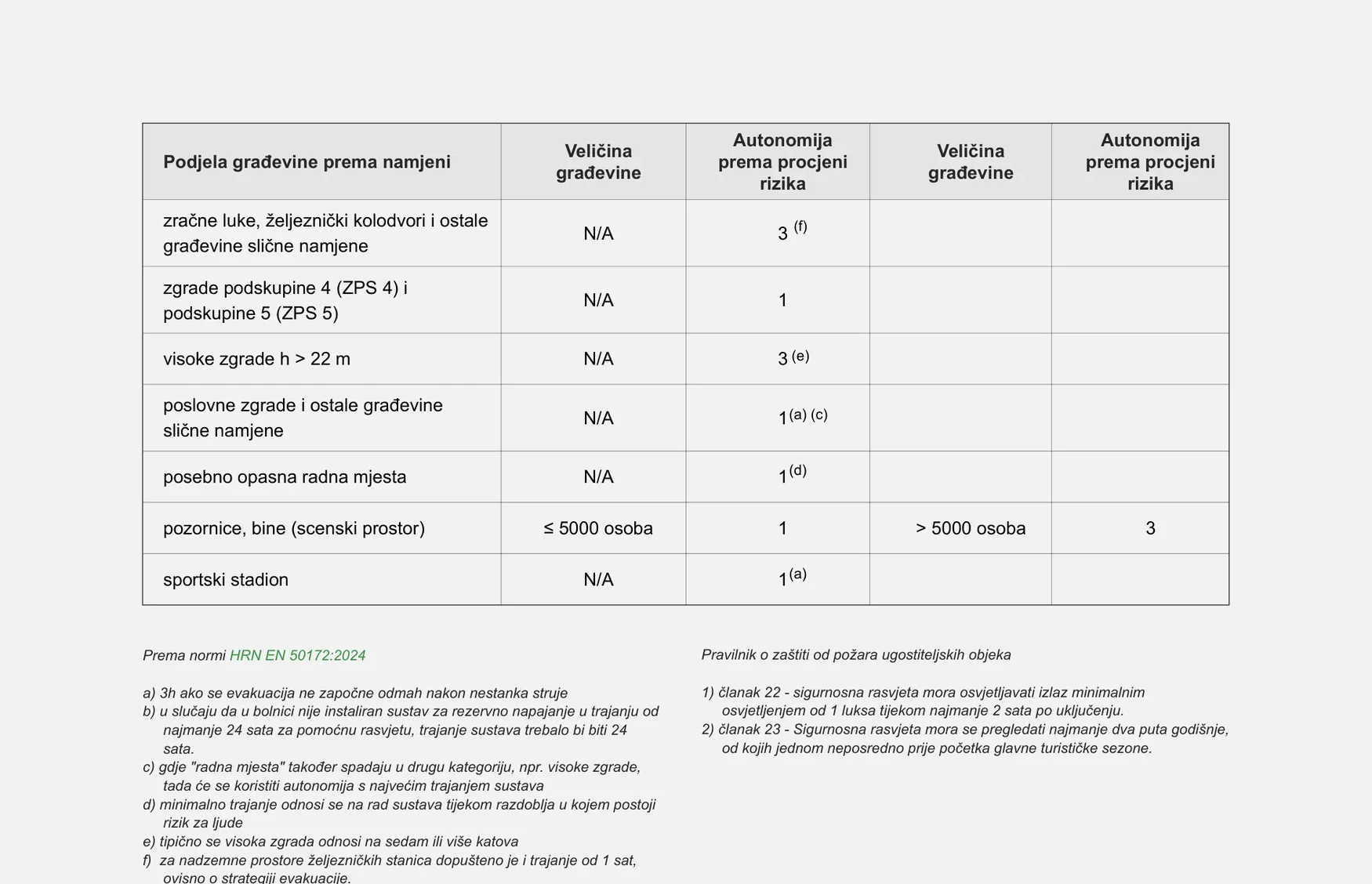
| Building type / use | Building size | Autonomy (h) | Other building size | Autonomy (h) |
|---|---|---|---|---|
| Airports, railway stations and similar buildings | N/A | 3 (f) | — | — |
| Buildings of subgroup 4 (ZPS 4) and subgroup 5 (ZPS 5) | N/A | 1 | — | — |
| High-rise buildings, h > 22 m | N/A | 3 (e) | — | — |
| Office buildings and similar buildings | N/A | 1 (a)(c) | — | — |
| Particularly hazardous workplaces | N/A | 1 (d) | — | — |
| Stages and performance areas | ≤ 5000 people | 1 | > 5000 people | 3 |
| Sports stadiums | N/A | 1 (a) | — | — |
Notes reproduced from the source handbook (HRN EN 50172:2024 and the hospitality fire-protection regulation):
- (a) Three hours if evacuation does not begin immediately after the power failure.
- (b) If a hospital has no standby supply lasting at least 24 hours, the system duration must be 24 hours.
- (c) High-rise workplaces may fall under another category; the longest required duration applies.
- (d) The minimum duration is determined by the risk to people.
- (e) A high-rise building typically means seven or more storeys.
- (f) One hour may be permitted in above-ground railway station areas, depending on evacuation strategy.
- (1) Hospitality fire-protection regulation: at least 1 lx for at least two hours after activation.
- (2) Emergency lighting is inspected at least twice yearly, including once just before the main tourist season.
OPERATING MODES OF EMERGENCY LUMINAIRES
MAINTAINED MODE (maintained mode)
In this operating mode, the luminaires remain illuminated during normal operation (powered by the mains supply). When mains power fails, the luminaire switches automatically to the secondary power source (its own battery or a central battery).
NON-MAINTAINED MODE (non-maintained mode)
Luminaires in this mode are not illuminated during normal operation. They light up only when the mains supply fails, at which point they automatically switch to the secondary power source.
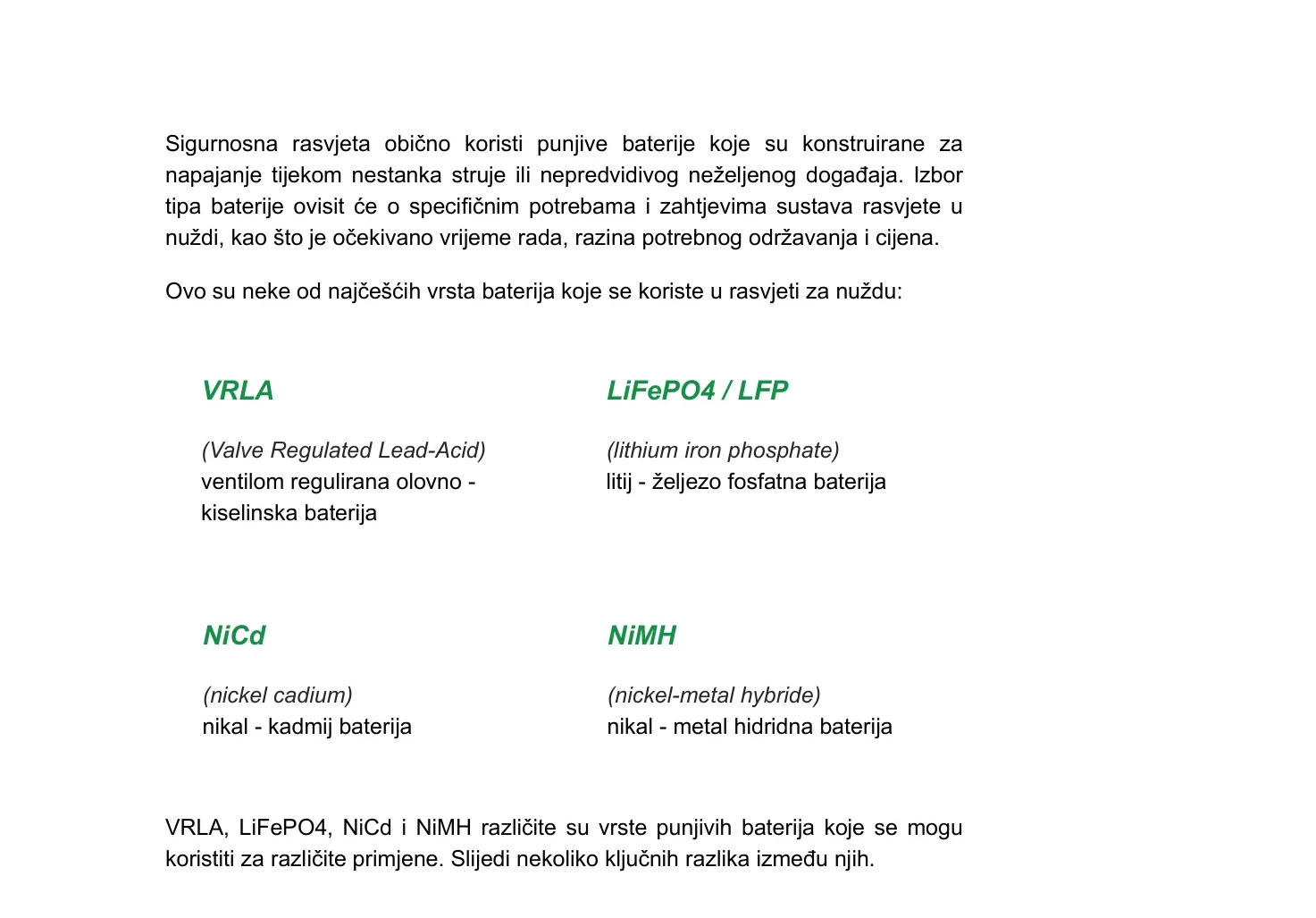
CONSTRUCTION OF RECHARGEABLE BATTERIES
Emergency lighting normally uses rechargeable batteries designed to supply power during an outage or unforeseen emergency. The battery type is selected according to the specific needs and requirements of the emergency lighting system, such as expected operating time, maintenance requirements and cost.
Some of the battery types most commonly used in emergency lighting are:
VRLA (valve-regulated lead-acid battery).
LiFePO4 / LFP (lithium iron phosphate battery).
NiCd (nickel-cadmium battery).
NiMH (nickel-metal hydride battery).
VRLA, LiFePO4, NiCd and NiMH are different types of rechargeable batteries used for various applications. The following pages explain several key differences among them.
CONSTRUCTION OF RECHARGEABLE BATTERIES 50
Main types of rechargeable batteries
VRLA (Valve-Regulated Lead-Acid)
There are two main types of VRLA battery:
ABSORBENT GLASS MAT BATTERIES (AGM)
AGM batteries are VRLA batteries that use a fibreglass mat to absorb the electrolyte, a mixture of sulphuric acid and water. The mat is compressed tightly between the lead plates, while a valve regulates the pressure inside the battery. AGM batteries are known for their relatively high energy density, low maintenance requirements and resistance to vibration and shocks. They are normally used for backup power and emergency lighting, as well as renewable energy systems, telecommunications and medical equipment.
GEL BATTERIES
Gel batteries are another type of VRLA battery that uses a gel-like electrolyte instead of a liquid one. The gel is produced by adding silica to the electrolyte, increasing its viscosity and preventing leaks or spills. Gel batteries are known for long service life, low self-discharge rates and good tolerance of deep discharging. They are typically used for backup power and emergency lighting, as well as renewable energy systems, marine applications and mobility scooters.
Both AGM and gel batteries are sealed and require no special maintenance. They have similar safety characteristics, making them suitable for indoor use, and are relatively inexpensive compared with other battery types (LiFePO4, NiMH). However, their service life and energy density are lower than those of LiFePO4 batteries.
VRLA — ADVANTAGES
Maintenance-free: VRLA batteries are sealed and do not need maintenance, making them a suitable choice for backup power.
Minimal ventilation requirements: VRLA batteries do not normally produce gas in normal operation, so special ventilation is not necessary.
Long service life: VRLA batteries typically last approximately 5–10 years, depending on usage and environmental conditions.
Moderate operating temperature range: 20°C–25°C.
Low self-discharge: VRLA batteries have a low self-discharge rate and can remain charged for a long period without recharging.
VRLA — DISADVANTAGES
Lower energy density: VRLA batteries store less energy per unit of weight and volume than other battery types (approximately 30–40 Wh/kg).
Sensitivity to overcharging: Overcharging can damage VRLA batteries, shorten their service life or even cause failure.
Limited depth of discharge: VRLA batteries should generally not be discharged beyond a certain level, typically around 50%, to avoid damage.
Sensitivity to high temperatures: Although they operate over a broad temperature range, prolonged exposure to high temperatures can shorten their service life.
CONSTRUCTION OF RECHARGEABLE BATTERIES 52
LiFePO4 / LFP (LITHIUM IRON PHOSPHATE)
LiFePO4 is a type of rechargeable battery that uses lithium and iron phosphate as electrode materials. LiFePO4 batteries are known for high energy density, long service life and safety features. They are becoming increasingly popular in applications such as electric vehicles, renewable energy storage and backup power systems.
Compared with other lithium-ion batteries, LiFePO4 batteries are considered safer because they are less prone to thermal runaway (and do not normally release gas) and overheating. They also have a longer service life and can withstand more charging and discharging cycles. In addition, LiFePO4 batteries are environmentally preferable because they do not contain toxic materials such as cobalt.
In emergency lighting, LiFePO4 batteries provide a high energy density in a compact, lightweight package. They also offer a long service life, low maintenance requirements and a wider operating temperature range of 20°C–35°C. However, they may be more expensive than VRLA and NiCd batteries, which can be an important selection criterion.
LiFePO4 / LFP — ADVANTAGES
No normal gas evolution: A system equipped with this battery type does not require ventilation for battery gases.
High energy density: Compared with VRLA batteries, LiFePO4 batteries can deliver more energy in a smaller package (approximately 90–120 Wh/kg), making them suitable for emergency lighting systems.
Long service life: They can undergo numerous charging and discharging cycles without significant capacity loss, providing reliable power for many years.
Fast charging: They can be recharged quickly, which is important where an emergency lighting system needs to recharge soon after an outage.
Low toxicity: They do not contain hazardous chemicals such as lead or cadmium and are more environmentally friendly.
Low self-discharge rate: They can retain a charge for a long time, making them suitable for emergency lighting systems used infrequently.
Stable chemistry: LiFePO4 batteries are more stable than many other lithium-ion batteries and less susceptible to thermal runaway and related safety issues.
LiFePO4 / LFP — DISADVANTAGES
Lower voltage: LiFePO4 cells have a lower voltage than some other lithium-ion cells and may therefore be unsuitable for certain applications.
Higher cost: They are generally more expensive than other lithium-ion battery types, which can be a disadvantage.
Limited availability: They may be less widely available than other lithium-ion types, making procurement more difficult.
Specialised charging equipment: They require suitable charging equipment, potentially increasing the cost and complexity of an emergency lighting system.
Sensitivity to cold: Performance may decline in very cold conditions, although the batteries perform well in warm environments.
CONSTRUCTION OF RECHARGEABLE BATTERIES 54
NiCd (NICKEL-CADMIUM)
NiCd batteries are rechargeable batteries using nickel oxide hydroxide and metallic cadmium as the positive and negative electrode materials. They are known for reliability, relatively high energy density and tolerance of extreme temperatures. This has made them popular in a range of applications, including emergency lighting, power tools and aviation.
In emergency lighting, NiCd batteries can provide a reliable and cost-effective backup supply. They withstand frequent discharge and recharge cycles and are therefore suitable for emergency luminaires that require regular tests and use. NiCd batteries also have a low self-discharge rate, allowing them to retain their charge for longer than many alternatives.
However, their disadvantages must be considered. Their energy density is lower than that of some other battery types, so a larger physical battery may be needed to provide the same amount of energy. NiCd batteries also contain toxic cadmium, which can harm the environment if not disposed of properly. The source handbook refers to restrictions under the EU Batteries Directive 2006/66/EC, which came into force in September 2006, while noting exemptions for emergency lighting and safety systems such as alarms and certain medical equipment. The applicability of these legal provisions must be checked against the current legislation.
For these reasons, some users choose other battery chemistries, such as VRLA, LiFePO4 or NiMH, for emergency lighting.
NiCd — ADVANTAGES
High reliability and durability: NiCd batteries can withstand challenging conditions, including low temperatures, and resist physical damage.
Fast charging: A key advantage is their ability to recharge rapidly, often within an hour, making them suitable for applications where rapid recharging matters.
Good high-current performance: They can deliver high output currents for power-intensive devices, including power tools and some vehicles.
Many charge/discharge cycles: They can withstand thousands of cycles without a substantial reduction in capacity.
NiCd — DISADVANTAGES
Memory effect: NiCd batteries can suffer from a memory effect in which maximum capacity decreases if they are not fully discharged before recharging.
Toxicity: Cadmium is a toxic heavy metal, creating disposal and recycling concerns and making these batteries less attractive environmentally.
Periodic maintenance: NiCd batteries require regular maintenance, including periodic discharge and recharge cycles, to maintain maximum capacity.
Lower energy density: Compared with other battery chemistries, a larger battery is needed to deliver the same energy (approximately 40–60 Wh/kg).
CONSTRUCTION OF RECHARGEABLE BATTERIES 56
NiMH (NICKEL-METAL HYDRIDE)
NiMH batteries can be a good choice for emergency lighting because of their long service life, high energy density and ability to withstand high discharge rates.
Self-discharge rate: NiMH batteries have a higher self-discharge rate than many other battery types. They lose their charge faster when not in use and may therefore be less suitable for emergency lighting systems.
The discharge rate is also important, as emergency lighting frequently requires a high discharge rate to provide bright illumination rapidly. An NiMH battery with a high discharge rate should therefore be chosen, preferably a type specifically designed for high-drain applications such as emergency lighting.
Proper care is important: batteries should be stored in a cool, dry place and their charge level checked periodically to ensure that they are ready for use in emergencies. NiMH batteries are rechargeable and require regular maintenance to remain in good condition.
NiMH — ADVANTAGES
Higher energy density: NiMH batteries have a higher energy density than NiCd batteries, storing more energy in an equivalent or smaller volume (approximately 60–120 Wh/kg).
Lower environmental impact: They do not contain cadmium, a toxic heavy metal found in NiCd batteries. This makes them more acceptable under environmental regulations and easier to recycle.
Long service life: Although NiMH batteries may not offer as many cycles as NiCd batteries, they still provide a useful number of charging and discharging cycles and are suitable for emergency lighting not in continuous use.
Good low-temperature performance: NiMH batteries generally work well at lower temperatures, making them reliable for outdoor emergency lighting and cold environments.
NiMH — DISADVANTAGES
Greater susceptibility to the memory effect than Li-ion batteries: Although less pronounced than in NiCd cells, the memory effect may occur in NiMH cells if they are not used correctly. This can affect capacity and performance if batteries are not periodically discharged fully.
Self-discharge: NiMH cells have a higher self-discharge rate than Li-ion and NiCd cells and may lose stored energy more quickly when unused for long periods.
Overcharge sensitivity: Overcharging can reduce service life and performance. Suitable chargers and charge management systems are therefore important.
Risk of leakage and damage: High temperatures can cause leakage or even cell breakdown, resulting in short circuits or damage to the device.
CONSTRUCTION OF RECHARGEABLE BATTERIES 58
SUPERCAPACITORS IN EMERGENCY LIGHTING (supercapacitor)
Supercapacitors are energy storage devices capable of storing and releasing energy very rapidly. They are often used in emergency lighting because they can provide a reliable backup supply when normal power fails.
Compared with conventional batteries, supercapacitors offer several advantages for emergency lighting. Their service life is considerably longer, they charge and discharge much faster, and they are less likely to leak or deteriorate over time. They are also environmentally preferable because they do not contain hazardous chemicals or heavy metals.
Overall, supercapacitors can be an excellent choice for emergency lighting systems owing to their reliability, durability and rapid charging capability.
Luminaires equipped with supercapacitors require practically no maintenance over a service life of up to 15 years or longer. Depending on the manufacturer, they operate across a wide temperature range, from −40°C to +70°C, and can therefore be installed outdoors, for example in shelters and car parks.
Supercapacitors are an innovative emergency lighting power solution offering the reliability and fast response often required in emergencies. They can significantly improve system performance and reliability, notwithstanding challenges related to energy density and cost.
SUPERCAPACITORS — ADVANTAGES
Rapid charging and discharging: Supercapacitors charge and discharge extremely quickly, enabling almost instantaneous activation of emergency lighting following a supply failure.
Long service life: They can withstand hundreds of thousands to millions of charge/discharge cycles without significant capacity loss, making them suitable for emergency lighting that may be activated repeatedly throughout its life.
Reliability in various environments: Supercapacitors resist extreme temperatures and mechanical damage and remain reliable in environments ranging from industrial facilities to outdoor locations.
SUPERCAPACITORS — DISADVANTAGES
Energy density: Supercapacitors store less energy per unit of mass than batteries and require more space for equivalent stored energy (approximately 5–10 Wh/kg).
Energy retention: Although their self-discharge rate is higher than that of batteries, their rapid recharging capability helps ensure they are ready for use.
Cost: The initial cost may be higher than for conventional batteries, although this can be offset by long service life and lower maintenance costs.
CONSTRUCTION OF RECHARGEABLE BATTERIES 60
CALCULATION OF BATTERY VENTILATION
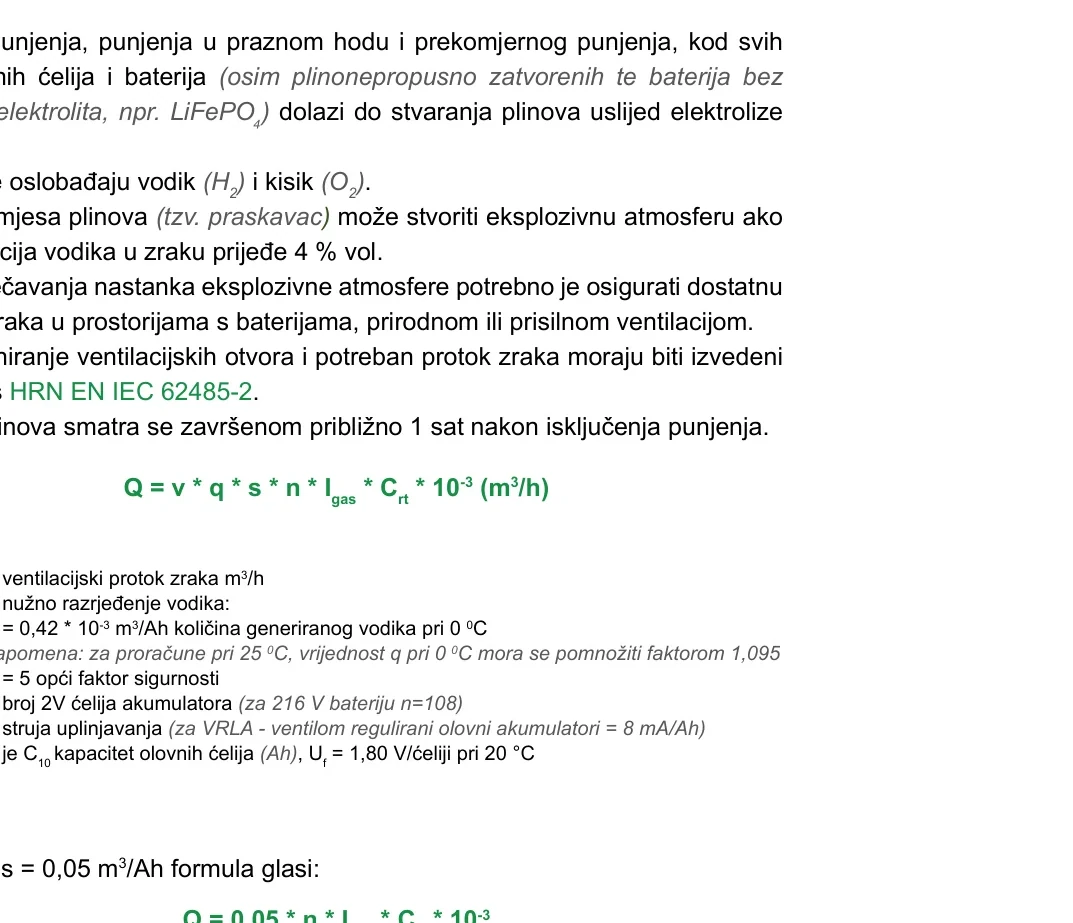
During charging, float charging and overcharging, all secondary cells and batteries (except gas-tight sealed types and those without an aqueous electrolyte, such as LiFePO4) generate gases through the electrolysis of water.
Hydrogen (H2) and oxygen (O2) are released. The resulting gas mixture (oxyhydrogen gas) can form an explosive atmosphere if the hydrogen concentration in air exceeds 4% by volume.
To prevent an explosive atmosphere, sufficient air exchange must be provided in battery rooms by natural or forced ventilation. Ventilation openings and the required airflow must be dimensioned in accordance with HRN EN IEC 62485-2.
Gas emissions are deemed to have ceased approximately one hour after charging is switched off.
Q = v × q × s × n × Igas × Crt × 10^-3 (m³/h)
Where:
Q – ventilation airflow in m³/h.
v – hydrogen dilution requirement.
q = 0.42 × 10^-3 m³/Ah – amount of hydrogen generated at 0°C. Note: for calculations at 25°C, multiply the q value at 0°C by 1.095.
s = 5 – general safety factor.
n – number of 2 V battery cells (n = 108 for a 216 V battery).
Igas – gas-producing current (for VRLA, valve-regulated lead-acid batteries: 8 mA/Ah).
Crt – C10 capacity of lead-acid cells (Ah), Uf = 1.80 V/cell at 20°C.
Since v × q × s = 0.05 m³/Ah, the formula becomes:
Q = 0.05 × n × Igas × Crt × 10^-3.
Battery ventilation calculation
BATTERY VENTILATION CALCULATION — EXAMPLE
Ventilation airflow is normally provided by natural ventilation. If this is impossible, mechanical (forced) ventilation must be used.
Battery rooms or enclosures with natural ventilation must have both an air inlet and an air outlet. The minimum free area of the openings must be calculated using the prescribed formula.
Q – ventilation airflow (m³/h).
A – free area of inlet and outlet openings (cm²).
28 – constant for natural ventilation calculations.
A = 28 × Q.
EXAMPLE CALCULATION
Battery set:
Sealed battery blocks according to IEC 60896-21, IEC 60896-22 and HRN EN 62485-2.
Service life: more than 10 years according to EUROBAT.
Design according to HRN EN 50171, with 25% reserve capacity.
Selected to provide a minimum operating duration of 60 minutes.
Battery type/capacity: 54 Ah.
Battery chemistry/type: hermetically sealed, maintenance-free valve-regulated lead-acid accumulators (VRLA/AGM).
Housing: acrylonitrile butadiene styrene (ABS).
Internal resistance: 18 × 7.2 mΩ.
Voltage per battery: 12 V.
Capacity per battery (at 20°C, 1.75 V per cell): 54 Ah.
Number of cells: 108.
Total number of batteries: 18.
Q = 0.05 × n × Igas × Crt × 10^-3.
Q = 0.05 × 108 × 8 × 54 × 0.001 = 2.33 m³/h.
From these data, the required cross-section for natural ventilation is:
A = 28 × Q.
A = 28 × 2.33 = 65.30 cm².
BATTERY VENTILATION CALCULATION 62